
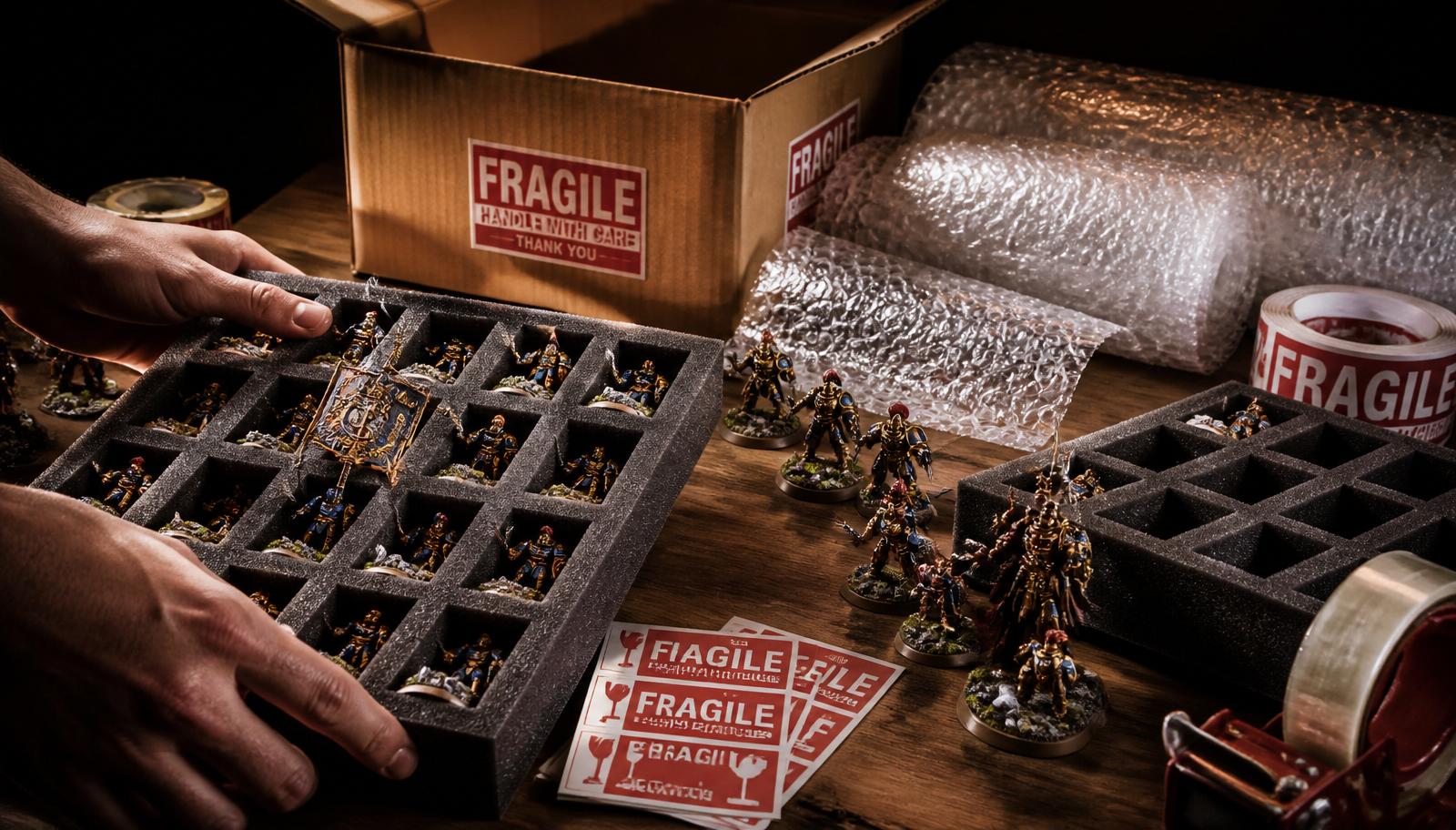
How to Pack and Ship Miniatures Safely
The exact protocol our studio uses to receive Warhammer, Age of Sigmar and historical armies from clients across Europe and North America — without a single broken banner in years.
Handing an army over to a courier is the single moment where months of painting can be undone in seconds. This guide walks you through the same packing standard we require from every commission client — and that we apply when we ship finished projects back.
Why generic packing fails miniatures
Miniatures are top-heavy, glued at fragile joints and often magnetised. A standard shoebox with crumpled paper transfers every impact directly to spears, banners, weapon barrels and thin ankles. The three failure modes we see when packages arrive badly protected are always the same: snapped weapons, detached bases and paint chipped where two models rubbed against each other in transit.
What you'll need
- A sturdy inner box sized to the army, plus a larger outer box (double-boxing).
- Large-bubble wrap for the outer void and small-bubble wrap for individual models.
- Foam trays (KR Multicase, Feldherr, Battle Foam) or a block of pluck foam.
- Acid-free tissue paper — never newspaper, the ink transfers onto matte varnish.
- Reinforced packing tape (50 mm minimum) and Fragile / This Side Up labels.
- Small cardboard boxes or rigid plastic containers to group units inside the inner box.
- Packing peanuts or paper filler for the remaining voids, scissors and a marker for labelling.
- Zip bags for magnetised parts, spare bits and any loose components.
Step 0 · Clean and inventory the army
Before anything is wrapped, dust every model with a soft brush or a short burst of compressed air. Dust trapped under bubble wrap acts like fine sandpaper over hundreds of kilometres of vibration, and it dulls matte varnish. Check glue joints too: anything already loose will certainly arrive detached, so re-glue and let it cure fully before packing.
Then write an inventory: units, model counts and any part that travels separately. Photograph each unit before wrapping. That list is what we check the shipment against on reception, and it is also the evidence a courier will ask for if you ever need to open a claim.
Step 1 · Immobilise each miniature
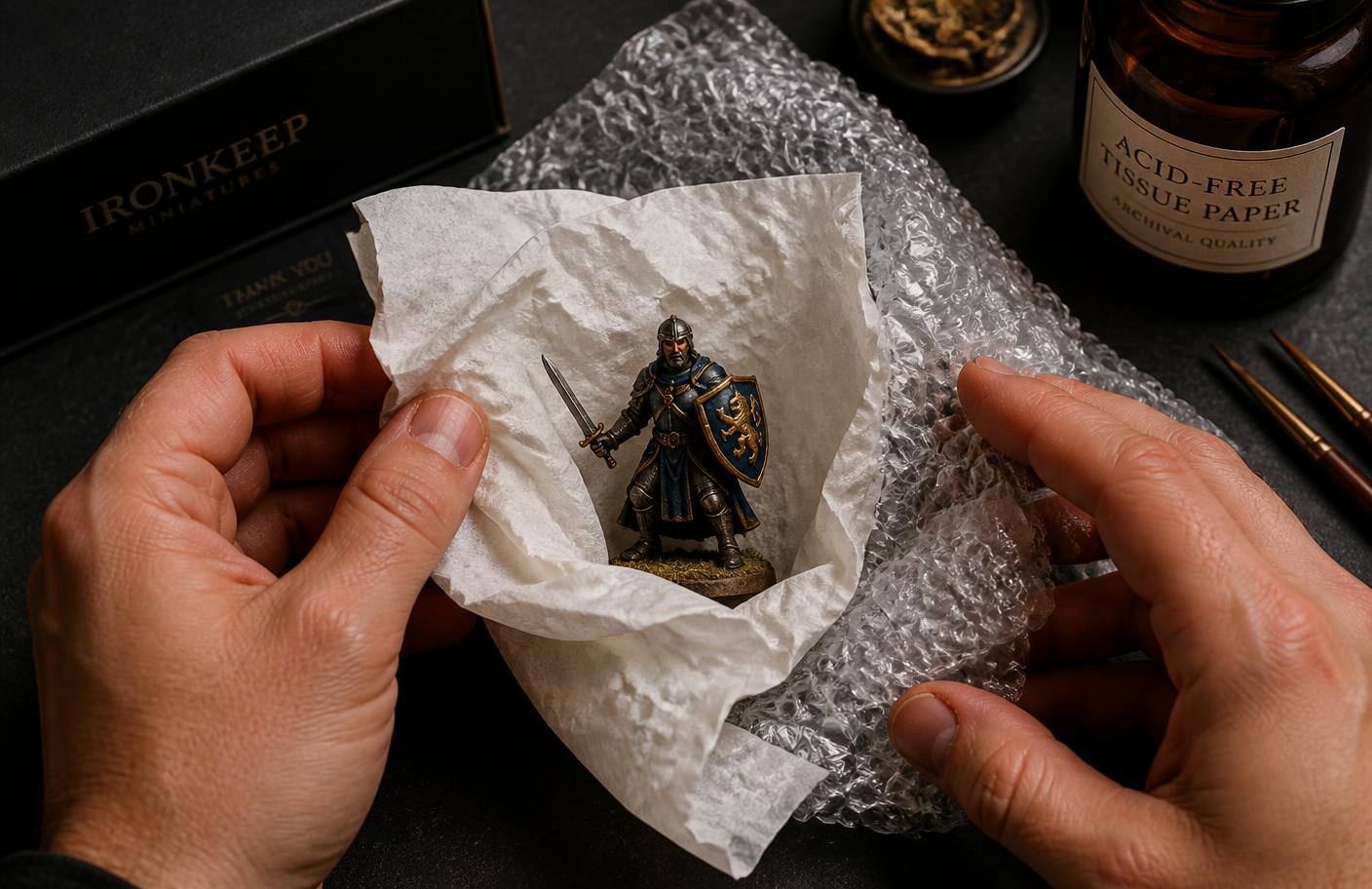
Wrap every model individually. First a layer of acid-free tissue to protect the varnish, then small-bubble wrap. Banners, spears, antennae and freehand shields get a second wrap and, when possible, a small cardboard sleeve. Magnetised parts (swappable weapons, character heads) travel in a labelled zip bag inside the same box — never loose.
Step 2 · Use foam trays or pluck foam
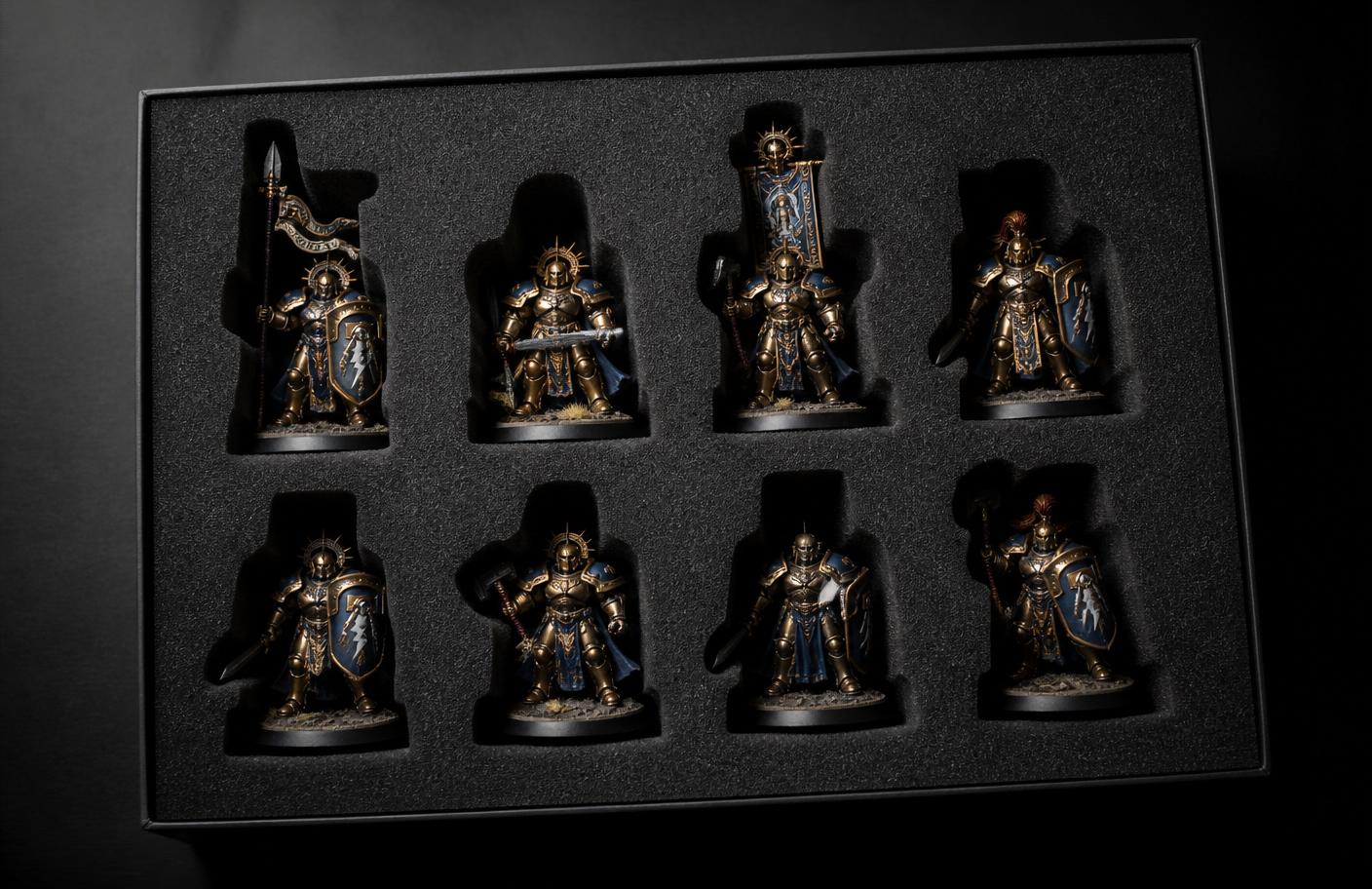
Foam is the difference between "it survived" and "it arrived pristine". Seat each miniature in a cut cavity so it cannot move in any direction. Bases must never touch another model. For large centrepieces (knights, monsters, vehicles) we recommend a custom pluck-foam cavity with 2 cm of foam on all six sides.
If you don't own foam trays, a well-executed alternative is a shallow cardboard grid taped inside the inner box, with each cell fully packed in small-bubble wrap. It's slower, but it works.
Group each unit into its own small box or rigid container, fill every remaining void with peanuts or crumpled paper so nothing shifts, and write the contents on the outside with a marker ("Intercessors ×10", "Character weapons — magnets"). Labelled containers keep the unboxing orderly on our side and make the inventory check immediate.
Step 3 · Double-box the parcel
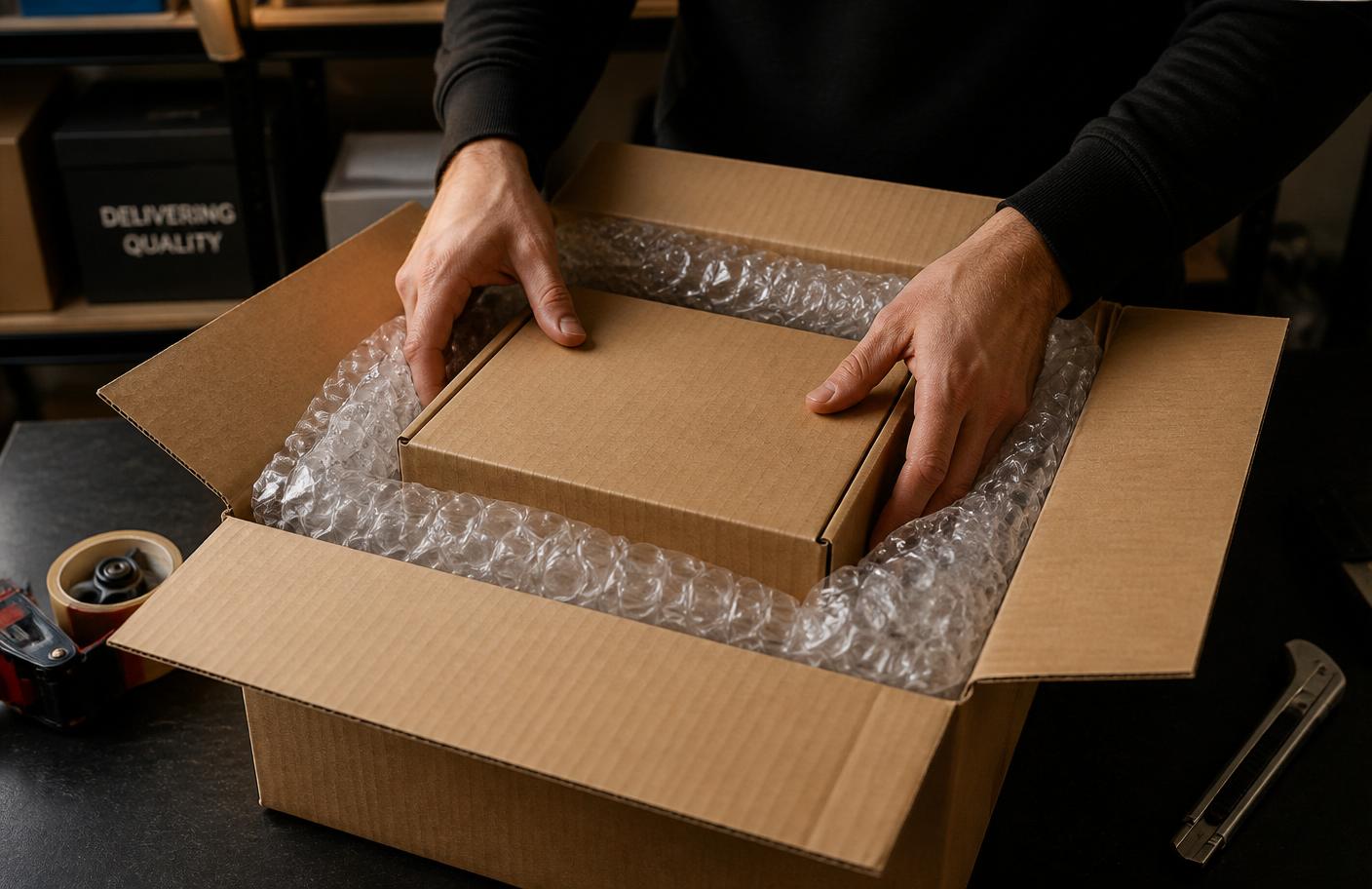
This is the non-negotiable rule. The inner box goes inside a larger outer box with at least 5 cm of large-bubble wrap on every side. The inner box must not touch the outer walls at any point — shake the closed parcel gently: if you hear or feel movement, add more filler.
Step 4 · Seal, label, photograph
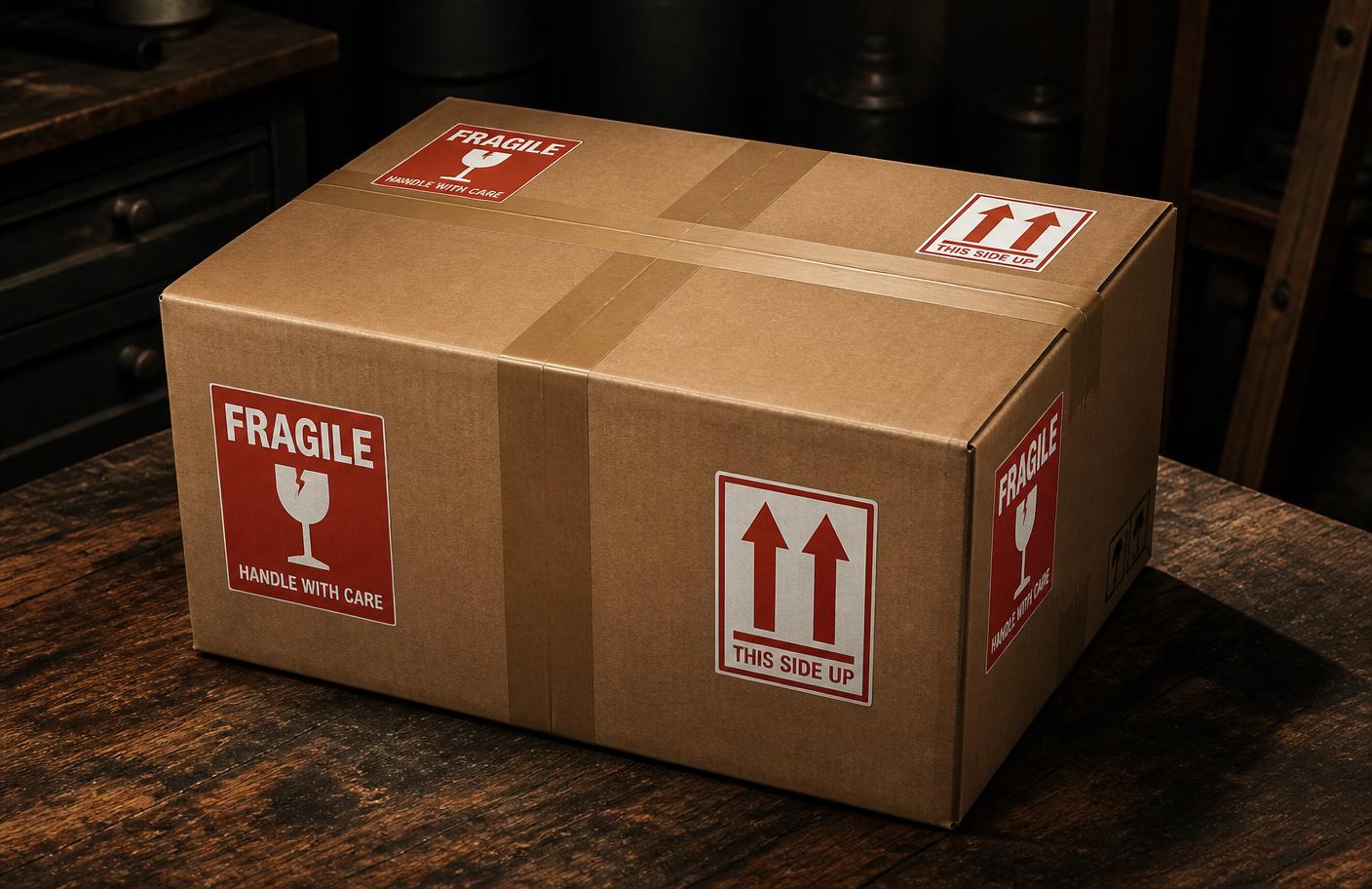
Reinforce all seams with an H-taping pattern (a strip along the central seam plus one across each end). Add Fragile and This Side Up labels on all six faces — couriers rarely respect orientation, but visible labels reduce rough handling. Before dropping the parcel off, photograph it from every angle: it's your proof if you need to file an insurance claim.
Step 5 · Ship with tracking and insurance
Never ship a painted army with an untracked service. Use a courier that offers real-time tracking and declare the true replacement value of the miniatures — not just the retail price of the plastic. Standard courier liability caps (often €25–€50) do not cover a tabletop-ready force. We regularly ship declared values above €1,500 and the extra insurance premium is small compared to the work at stake.
Choose a service used to fragile collectibles, prefer express tiers (fewer days in transit means fewer handling points) and avoid dispatching on a Friday, when parcels often sit in a depot over the weekend. Keep the receipt and the tracking number: without them, an insurance claim has no starting point.
Step 6 · After dispatch: track, notify, inspect
Packing well is only half the job. Follow the tracking daily and react early to an "exception" or "held at depot" status — most couriers only accept damage or loss claims within a short window (often 7 to 14 days from delivery).
Send the recipient — us, or a client of yours — the tracking number and the estimated delivery date, plus the inventory and the photos of the sealed parcel. On arrival, open the box on camera before removing anything, check the contents against the inventory, and photograph any crushed corner or broken part immediately. Documented evidence, gathered at the moment of unboxing, is what turns a claim into a refund instead of an argument.
Studio checklist — the standard we ask from clients
- Every miniature individually wrapped, banners double-wrapped.
- Foam trays or pluck foam so nothing moves inside the inner box.
- Inner box inside a larger outer box, 5 cm of bubble on all sides.
- H-taping and Fragile labels on all six faces.
- Tracked, insured courier with declared replacement value.
- Photos of the sealed parcel sent to us before handover.
What happens when your army arrives at the studio
On reception we unbox on video, inventory every piece against your list and send you a full photo report within 24 hours. If anything arrived damaged in transit we document it immediately so you can open a claim with the courier — and we glue, pin or restore small breaks before painting begins, at no extra cost.
When the commission is finished, we return the army using this exact same protocol: double-boxed, foam-lined, insured and tracked door to door. It's why we can confidently accept armies from anywhere in Europe, the UK and North America.
Frequently asked questions
Can I ship unassembled sprues instead of built models?
Yes — and it's often safer. Sprues travel flat, don't have fragile joints and let us assemble with pinning and magnetising options discussed up front. Keep sprues in their original bags inside a padded envelope, then inside the inner box.
What about primed or partially painted miniatures?
Treat them like finished models: individual tissue + bubble wrap, foam cavities, no base-to-base contact. Primer and unvarnished paint layers are far more prone to chipping than a fully varnished army.
Which couriers do you recommend?
Within the EU we've had the best experience with UPS, DHL Express and GLS Business Parcel with declared value. From the UK, Parcelforce Global Priority and DHL Express both handle miniatures well. Always pay the tracked + insured tier — the cheapest label is never worth the risk.